
The Ottoman Empire: Suleiman the Magnificent and Roxelana
The television series *Magnificent Century* captivated millions, but much of its story is fictionalised. Discover what historians know about Suleiman the Magnificent, Roxelana (Hürrem Sultan), and the extraordinary era in which they lived.
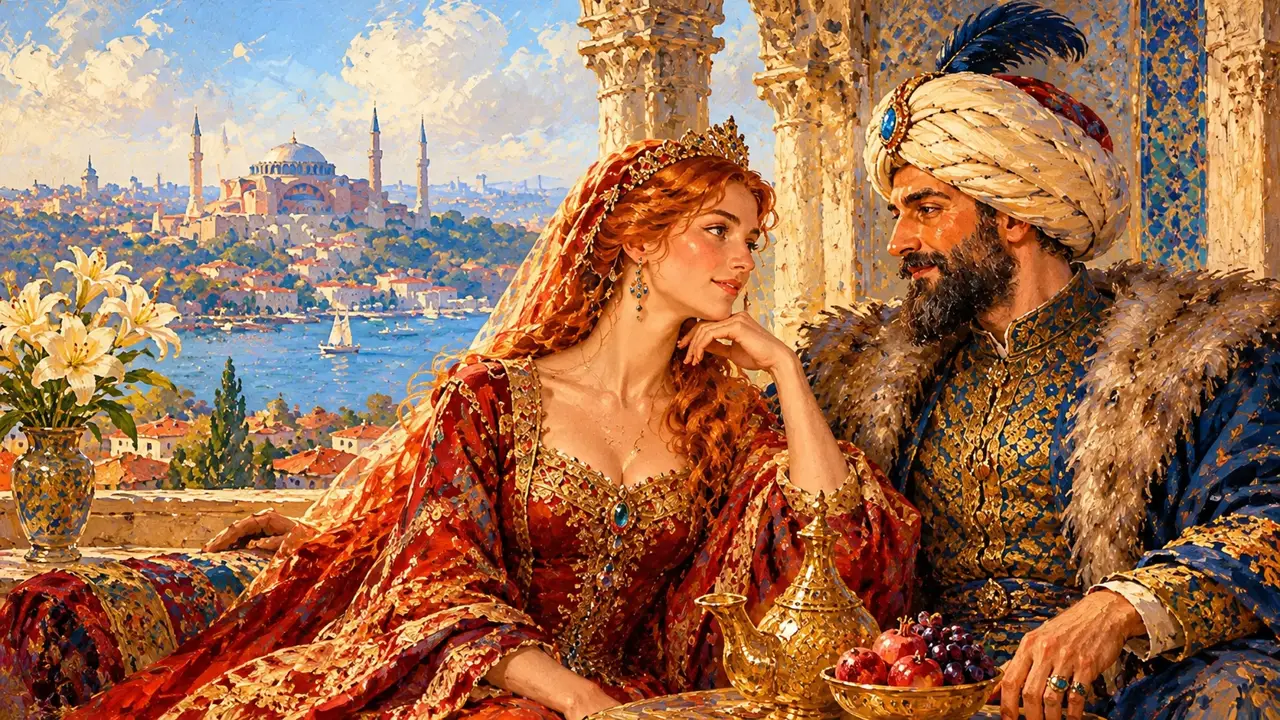
The Ottoman Empire: Suleiman the Magnificent and Roxelana
Millions of viewers fell in love with the television series Magnificent Century, although its portrayal of history contains a considerable amount of artistic invention. Since Turkey is a country we care deeply about, it is worth exploring some of the history behind the drama.
This is the story of the Ottoman Empire, Suleiman the Magnificent and Roxelana — the woman who became Hürrem Sultan.
The Great Turk
In Europe, Suleiman was known as the Great Turk and the Grand Seigneur. He lived from 1494 to 1566 and was known in the Ottoman world as Süleyman Kanuni — Suleiman the Lawgiver.
His official titles were extraordinarily elaborate, describing him as the ruler of numerous kingdoms and the sovereign of the Mediterranean and Black Seas, Jerusalem and Egypt.
For a broader account of the Ottoman Empire, British historian Jason Goodwin's Lords of the Horizons: A History of the Ottoman Empire offers a fascinating perspective. Here, we will focus on some of the most remarkable episodes.
Suleiman ascended the throne in 1520 following the death of his father, Selim I. He inherited an already powerful and wealthy empire. Several generations earlier, in 1453, Sultan Mehmed II had conquered Constantinople.
The Ottomans fought numerous campaigns, and the weather often complicated their military ambitions. The period from approximately the fourteenth to the nineteenth century is commonly associated with the Little Ice Age, a time of comparatively cool climatic conditions.
Heavy rainfall, difficult terrain and early cold weather could disrupt military operations. The unsuccessful Ottoman siege of Vienna in 1529 is one example of a campaign affected by challenging conditions.
The Foundations of an Empire
One of the Ottoman Empire's greatest strengths was its sophisticated administrative system.
Within its vast territories lived communities speaking different languages and practising different religions. In the Islamic political vocabulary of the period, the distinction was sometimes made between dar al-Islam, the abode of Islam, and dar al-harb, territories beyond Muslim rule.
Much of the empire's agricultural land was regarded as state land under the authority of the sultan.
Under the timar system, the right to collect revenue from certain lands was granted to cavalrymen in return for military service. These grants were not simply private property and were subject to state control, although inheritance and succession practices varied over time.
This arrangement helped maintain the central authority of the Ottoman government.
Suleiman was also known for the magnificence of his court. Gold brocade, precious stones and elaborate ceremonies reflected the power and wealth of the empire.
Yet behind the grandeur of military victories and imperial authority lay a complicated personal world. The greatest challenges of Suleiman's reign were not always found on the battlefield.
Some unfolded within his own family.
Mahidevran and Roxelana
Before Hürrem rose to prominence, Mahidevran held an important position in Suleiman's household.
She was the mother of Prince Mustafa, one of the leading candidates for succession, and enjoyed the sultan's favour for many years.
At that time, Ottoman rulers generally did not formally marry their concubines, making the later marriage between Suleiman and Hürrem especially unusual.
Relatively little is known with certainty about Roxelana's early life.
European contemporaries described her as coming from Ruthenia, a historical region that included parts of present-day western Ukraine. Her European name, Roxelana, reflected this geographical association.
She was probably captured during a Crimean Tatar raid and subsequently brought to Istanbul through the slave trade.
Much of the familiar story of her childhood comes from later traditions rather than contemporary documentation.
The town of Rohatyn, in present-day Ivano-Frankivsk Oblast, is frequently identified as her birthplace. This tradition can be traced to the seventeenth-century Polish poet Samuel Twardowski, although other places have also claimed the distinction.
The story that her father was an Orthodox priest named Gavrila Lisovsky appeared in later accounts.
The names Anastasia and Alexandra, often associated with Roxelana, likewise belong to literary and popular traditions rather than securely documented historical records.
How she entered the imperial palace is also uncertain.
According to one version, Ibrahim Pasha purchased her and presented her to Suleiman. Another tradition suggests that she was given to the sultan by his mother, Hafsa Sultan.
Neither account can be treated as conclusively established.
Contemporary descriptions suggest that Hürrem was admired less for conventional beauty than for her charm, intelligence and lively personality.
Her Ottoman name, Hürrem, comes from a Persian word meaning cheerful or joyful.
Her influence over Suleiman attracted considerable attention, and some contemporaries even attributed his attachment to her to supernatural powers.
Stories also describe her singing to the sultan, although there is no reliable evidence establishing what language those songs were in.
What is clear is that her position at court became exceptional.
According to contemporary accounts, Suleiman listened to her and valued her companionship, a relationship that stood out within the conventions of the imperial household.
Ibrahim Pasha
Ibrahim Pasha was one of Suleiman's closest companions and eventually became one of the most powerful figures in the empire.
He was an accomplished diplomat, military commander and statesman. His education, command of languages and political abilities made him indispensable to the sultan.
The splendour of his position was reflected in the honours bestowed upon him, including elaborate ceremonial insignia.
Over time, however, his extraordinary authority became increasingly controversial.
Foreign diplomats recorded statements suggesting that Ibrahim sometimes presented himself as possessing power almost equal to that of the sultan.
A famous tradition claims that Suleiman had once promised never to remove Ibrahim from office. According to the story, the sultan later consulted religious scholars to find a way around this oath.
The account belongs to historical tradition rather than firmly established fact.
What is certain is that Ibrahim Pasha was executed in 1536 at Topkapı Palace.
His fall remains one of the most dramatic episodes of Suleiman's reign.
Roxelana, Ibrahim and Giulia Gonzaga
The relationship between Roxelana and Ibrahim Pasha has inspired numerous stories.
If the tradition that Ibrahim introduced her to the palace were true, one might imagine that she would have felt gratitude towards him.
Instead, later narratives often portray the two as political rivals.
Another fascinating figure sometimes connected to these stories is Giulia Gonzaga, an Italian noblewoman celebrated for her beauty.
In 1534, the Ottoman admiral Hayreddin Barbarossa raided Fondi, where Giulia was staying.
According to accounts of the episode, the raid may have been intended to capture her and bring her to the Ottoman court.
Giulia escaped.
Later interpretations linked the attempted abduction to the rivalry surrounding Hürrem, although such explanations remain speculative.
Giulia's subsequent life was also marked by religious controversy. Her association with circles sympathetic to church reform attracted the attention of the Roman Inquisition.
Pope Pius V is sometimes credited with a severe remark about her religious correspondence, but the precise wording and circumstances belong to disputed historical accounts.
These episodes reveal how easily the politics of the Ottoman court became intertwined with European legend.
From Concubine to Wife
One story recounts that when Suleiman was presented with new concubines, Hürrem reacted so strongly that he refused them.
Whether the incident occurred exactly as described is uncertain, but it reflects the reputation she acquired in later narratives.
Around 1533–1534, Suleiman took the extraordinary step of formally marrying Hürrem.
For generations, Ottoman sultans had generally avoided formal marriage to women from the imperial harem.
Hürrem's marriage therefore represented a significant departure from established court practice.
She became not only the sultan's wife but also one of the most influential women in Ottoman history.
Historians differ in their assessments of the extent and nature of her political influence.
Nevertheless, her exceptional position at court, her correspondence and her involvement in charitable and architectural projects demonstrate that she occupied a remarkable place in the empire.
The Final Years of an Era
The later years of Suleiman's reign were overshadowed by struggles over succession.
In 1553, his son Mustafa was executed on the sultan's orders.
Another son, Bayezid, became involved in a conflict over the succession and fled to Persia. He was executed in 1561.
Hürrem had died three years earlier, in 1558.
Suleiman himself died in 1566 during the Ottoman campaign against the Hungarian fortress of Szigetvár.
The throne passed to Selim II, one of Hürrem's sons.
Some historians have traditionally regarded the period following Suleiman's death as the beginning of significant changes in the Ottoman political system.
Others consider the familiar narrative of imperial decline overly simplistic, noting that the empire remained a major political and military power for centuries.
What is beyond doubt is that Suleiman and Hürrem left an extraordinary legacy.
Their lives continue to inspire historians, writers and filmmakers, while the architecture and cultural heritage of their era remain visible throughout modern Turkey.
The traces of the Ottoman world are particularly striking in Istanbul, where imperial palaces, mosques and historic neighbourhoods preserve the memory of this remarkable period.
Explore more about Turkey in our Turkey Destinations section, or discover the history and neighbourhoods of Istanbulthrough INEST HOMES.