The Architecture of Loneliness: Why Grand Villas Don't Always Make Us Happier
We dream of spacious homes, expansive terraces, and complete privacy. But what happens when a home becomes too large, even for our dreams? A reflection on silence, human connection, and why beautiful architecture doesn't always guarantee happiness.
Imagine a villa spanning 600 square metres.
Five bedrooms. Seven bathrooms. Two living rooms. A private study. A home cinema. Terraces, a swimming pool, a garden.
Everything has been designed for comfort.
You could spend an entire day here without encountering another person.
And sometimes, that is precisely the problem.
Contemporary luxury architecture has become remarkably good at creating privacy. Separating spaces. Controlling sound. Designing independent areas for every member of the family.
Yet in eliminating unwanted noise, we sometimes eliminate something else.
The unexpected encounters from which closeness quietly grows.
We Once Lived Closer Together. And Met More Often.
In older homes, everyday life revolved around a handful of shared spaces.
The kitchen was a place for conversation. The living room belonged to several generations. Hallways made people cross paths. Around the dining table, even those who had spent the day apart would meet again.
There is no reason to romanticise cramped living conditions. A lack of personal space can be just as damaging to relationships.
But smaller homes often possessed something we risk losing as our living spaces expand.
They created opportunities to be together without having to arrange them.
In a large house, people can love one another deeply and still barely cross paths.
Everyone has their own bedroom, their own screen, their own routine, their own little world.
Gradually, the home becomes a beautiful collection of separate lives.
The Paradox of the Second Floor
There is a particular category of rooms that exist mainly in our imagination.
The library where we intended to read.
The gym where we planned to exercise every morning.
The guest bedroom no one ever uses.
The dining room for twelve, where two people eat dinner at one end of a long table.
When buying a large home, we often purchase space not for the life we actually lead, but for the life we imagine ourselves living one day.
We picture gatherings of friends, family celebrations, long summer evenings.
But architecture cannot create human connection on its own.
It can provide the perfect terrace for dinner.
The people around the table are another matter.
Not All Silence Feels the Same
Silence has become one of the defining symbols of modern luxury.
We leave noisy cities, buy homes on secluded hillsides, and choose properties with no neighbours in sight.
At first, the absence of noise feels extraordinary.
But there is a difference between silence we choose and silence we cannot escape.
One restores us.
The other can sometimes deepen our sense of isolation.
A house on a remote hillside may be perfect for someone who needs peace and solitude. Yet it may be entirely wrong for someone who thrives on spontaneous encounters, lively streets, and the reassuring presence of other people.
Distance from civilisation is not an advantage in itself.
It is a characteristic that needs to be considered in relation to the life we actually want to live.
Why the Happiest Places in a Home Are Often the Smallest
Think of a place where you feel completely at ease.
Perhaps it is an armchair beside a window.
A small kitchen filled with morning light.
A corner of a terrace with just enough room for two chairs.
Or a sofa where everyone somehow gathers, despite the many other places available.
Comfort is rarely measured in square metres.
More often, it emerges from a sense of human scale: the right ceiling height, the proximity of familiar objects, soft lighting, the quiet awareness of another person's presence.
A large space can feel intimate too. But achieving that requires more than beautiful architecture.
It requires understanding how people will actually live there.
Where they will meet.
Where they will retreat when they need to be alone.
And what will naturally bring them back together.
Architecture Can Bring People Together
A thoughtfully designed home does not have to be small.
A large villa offers a remarkable possibility: the freedom to enjoy privacy without sacrificing togetherness.
The difference lies in how its spaces are organised.
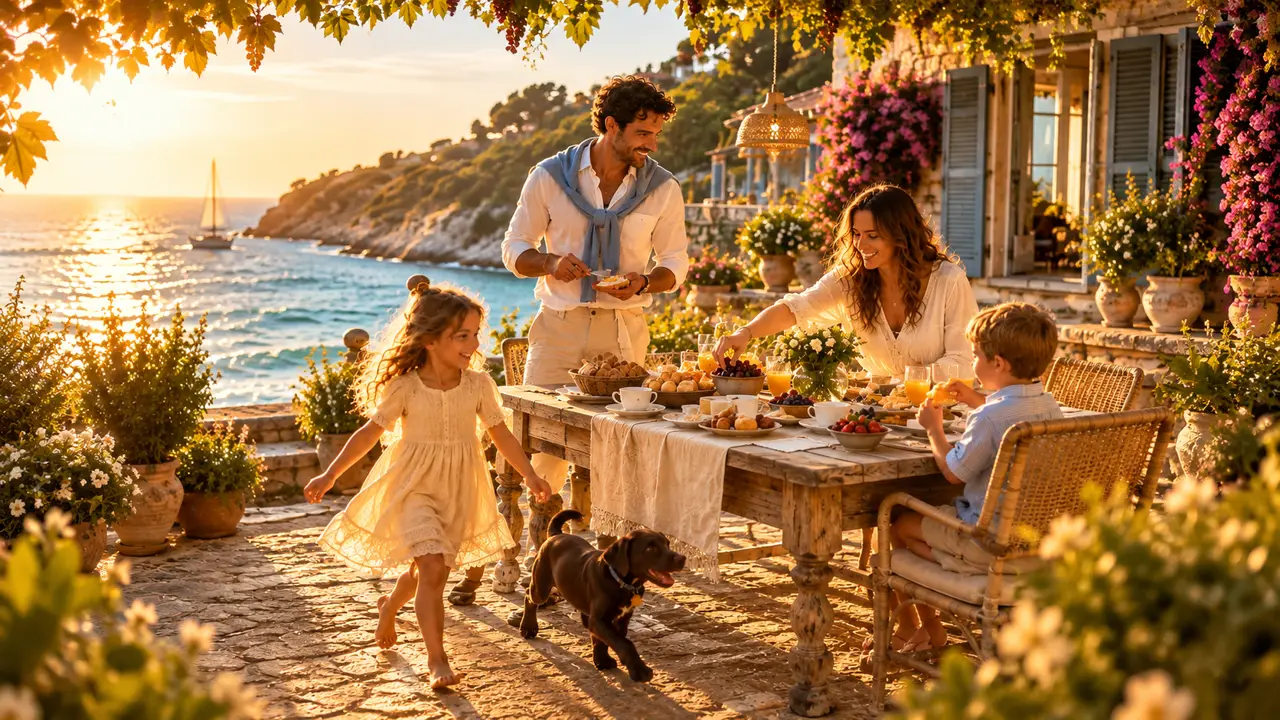
A shared kitchen where people genuinely want to cook. A terrace that flows naturally from the living room. A garden visible from several parts of the house. Small, inviting places for conversation rather than a single enormous formal lounge.
And perhaps most importantly, paths that cross.
Architecture cannot build relationships on our behalf.
But it can make encounters feel natural.
Or turn every meeting into something that needs to be planned.
Not Every Dream Needs to Be Big
In real estate, floor area remains one of the easiest qualities to understand.
More square metres. More rooms. More possibilities.
These things are easy to compare, evaluate, and sell.
It is far more difficult to ask a buyer a different question:
"How much space does your life actually need?"
Not your status.
Not other people's idea of success.
Not the imaginary version of yourself who hosts dinner parties every weekend, exercises daily, and spends evenings reading beside the fireplace.
Your real life.
The one filled with ordinary Tuesdays, tired evenings after work, quiet breakfasts, and moments when all you want is to sit beside someone you love.
The answer may be surprising.
For some, a large villa really is the ideal home — with children, parents, friends, and enough room for everyone to have a place of their own.
Others may be far happier in a house half the size, close to the sea, a favourite café, and the people they enjoy spending time with.
The Most Important Room
There is one question people rarely ask when viewing a property.
Where in this house will we spend the most time together?
Not where the most expensive sofa will stand.
Not which room has the finest view.
Not which space will impress our guests the most.
But where our everyday life will actually happen.
Because eventually, the excitement of a new property becomes familiar.
Marble stops feeling extraordinary. Panoramic windows become part of the daily landscape. The swimming pool is no longer a novelty.
And what remains is the very reason a home exists.
People.
And the possibility of being close to them.
A large house is not necessarily a happy home. A small one is not necessarily cosy.
Perhaps true luxury lies not in how much space we possess, but in how meaningfully we share it with others.